To hear my latest story click on Turkish Cultural Program 2 November 2013 Fast forward to 1 hour 29 minutes and 15 seconds (1.29.15) if you just want to listen to me, otherwise sit back and enjoy the show.
Monday, November 11, 2013

Wednesday, November 6, 2013
Display - Turkish Style
 |
| Ankara simits for sale in Karaköy, 2008 |
 |
| Fishing on the Galata Bridge, September, 2013 |
 |
| Would you like parsley with your lamb? Butcher shop window, Bergama, 2006 |
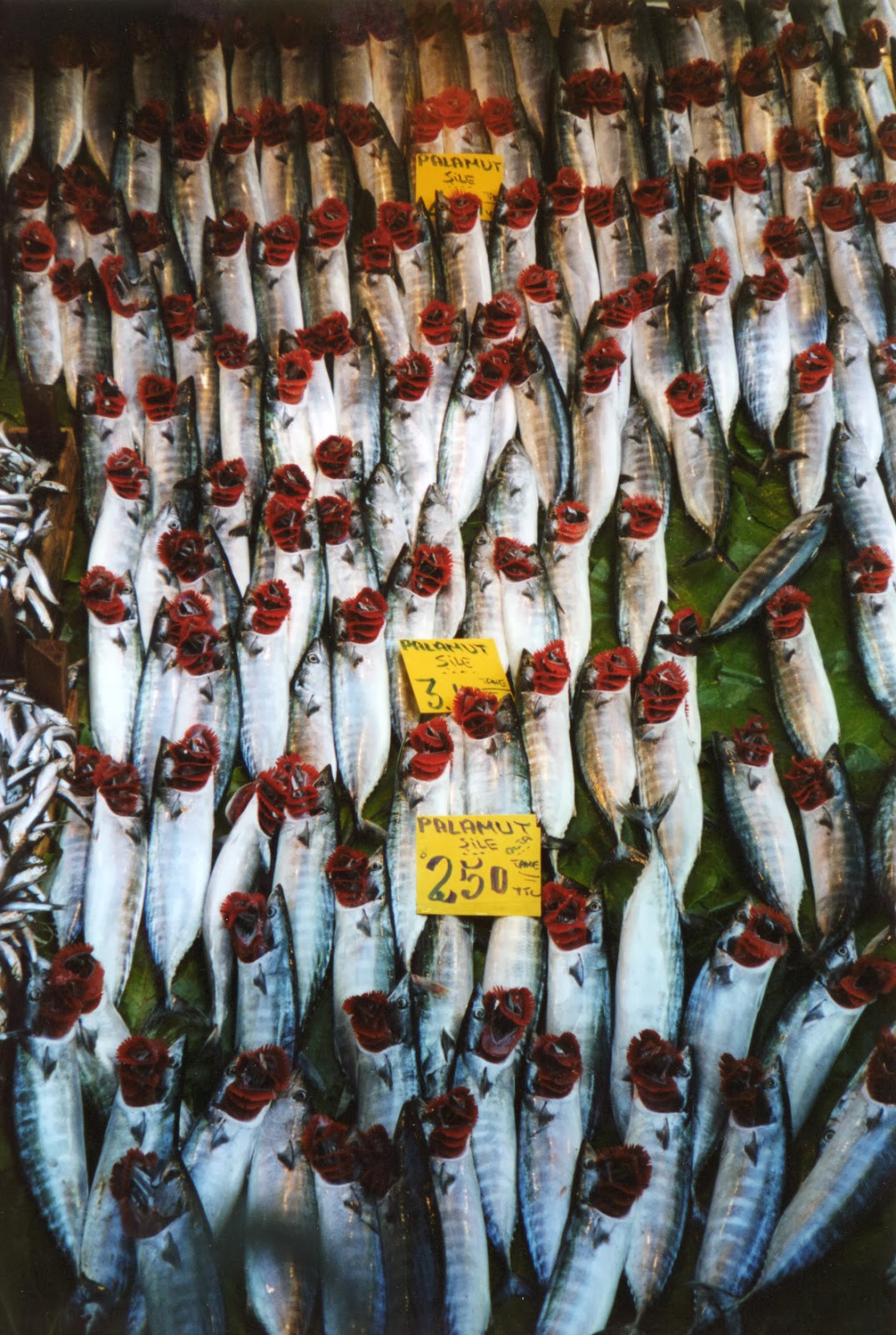 |
| Fish anyone? Kadiköy, 2006 and even now |
 |
 |
| Turşu (pickles) in Fish Street, Kadiköy, 2006 |
 |
| And the original, getting
married, Tahtakale, September, 2013 |
Tuesday, October 29, 2013
Turkish weddings

Unlike popular stereotypes about women, I
am not a great fan of shopping. True, I will go to great lengths to track down
the perfect shoe or boot, but when it comes to other items of apparel, I am far
less interested. Particularly when it comes to buying an outfit for a special
occasion. It’s like finding a taxi. They’re always there when you don’t want one, but nowhere to be seen when you’re standing in the pouring rain,
desperate to sit somewhere dry and save your new shoes from complete ruin.
When I received an invitation to a Turkish
friend’s wedding I was more than happy to accept. After all, this was my friend
getting married and I was very pleased for her. Then it struck me that a
wedding meant a new outfit, preferably a dress, which meant shopping for a
special occasion. Not a happy prospect. Nonetheless, I set off early on a
Saturday, armed with a long list of errands, including the purchase of the
dress. In the past when I’d been in the same situation I’d buy all the other
things first so that when I failed to find the one thing I really had to have, the
day wouldn’t be a total loss and I wouldn’t feel such a failure.
This time I decided to approach the mission
differently and planned to look for a dress first. Knowing where to look was
the easy part because when it comes to weddings, Kadıköy, my local shopping
area, has two important streets concerning all things matrimonial. Both lead
off an intersection of six streets officially called AltıYol, more commonly known
as boğa, or the bull, due to a statue
of one situated there. The statue was made in Paris
in 1864 by Isodore-Jules Bonheur and was taken to Germany during the Occupation in
WWI. It was then given to Enver Pasha as a present by the Germans in 1917. It
was placed in various locations around Istanbul
until it came to rest in Kadıköy in 1969. Despite recent attempts by the Ministry of
Museums to rehouse it in the gardens of Beylerbeyi Palace
it remains a popular meeting point and well-known landmark for locals and
foreigners alike.
As my bus crawled up the street towards the
bull I had ample opportunity to admire the latest tastes in wedding dresses. Everyone
knows where to go after the question has been popped, and it isn’t even
necessary to know the official name of the street. In Turkey it’s common to find
shops selling the same type of items side-by-side in the same road. so if you
say you are looking for wedding dress street even the most confirmed of
bachelor’s could direct you there. To my inexperienced eye this year's wedding
dresses seem to err slightly on the side of drag queen overkill with multiple
flounces of lace, diamante and ecru silk appliqué. When I spy mannequins
sporting tinsel wigs over rainbow electric coloured bridesmaids dresses scenes
from Priscilla Queen of the Dessert come
to mind. Nonetheless the shops are heaving with people so maybe I am being a
bit critical.
Once we reach the bull I hop off the bus
and head down the road leading away from the sea. Here is abiye street, a street full of shops dedicated to evening wear.
Unlike my own country where superstition rules that guests at a wedding should
never wear black, in Turkey
there is no such restriction. In fact it is quite acceptable to do so, if a tad
boring in the opinion of my more fashionable Turkish girlfriends. I am quite
pleased with this fact because I find the Turkish trend towards colour, a lot
of it, matching, clashing, and overlaid with sequins and other forms of decorations
rather overwhelming. One colour is enough for me, but from what I’ve seen in
the past, finding evening wear that isn’t neon and drenched in diamentes could
be quite a challenge.
Prepared for defeat but hoping for success
I march confidently into the first shop at the top of the street. I am
immediately surrounded by floor length strapless gowns whose garish colours
positively glow despite being shrouded in plastic. The colours are
quite blinding and I am momentarily stunned and unable to respond when approached by a saleswoman. After she welcomes me a second time I manage to
respond with the obligatory words “Hoş geldiniz”. I then launch into my well
rehearsed speech.
“Hello”, I say in Turkish. “I am foreign,
and I have been invited to a Turkish wedding. I want to buy a dress to wear. I
am short so I do not want a long dress.” Looking at the dresses on offer I add,
“I don’t like gold, I like silver. I don’t want anything too fussy.”
The woman, with the help of another
colleague who has emerged from the forest of plastic, begins to methodically
move around the shop and pulls out several dresses. These are brought to me for
approval and I quickly knock back a mottled olive green lace tube dress with
elbow length sleeves designed to cover all faults. I decide it wouldn’t be
politic at this point to say that I don’t particularly want a
mother-of-the-bride dress that makes me look like a short refrigerator with
legs. I tentatively agree to try on a fuscia satin number adorned with a very
small amount of gold beading around the neck, and a shapeless black jersey
crepe tube with a fall of tulle down the front. I can see it has potential, possibly
as a curtain in a funeral home, but I'm not sure how it will work as a dress.
Nonetheless I promised myself I would try on anything remotely suitable and go
outside my admittedly limited dress comfort zone to see if just this once, I
can go home with more than dashed hopes.
Inside the changing room I’m instructed to
strip down to my underwear. As soon as I give the signal the two women crowd
into the cabin with me, lift my hands above my head and slither the satin dress
onto my body. One holds me steady while the other fits my feet into staggeringly
high heeled strapless mules and then we all make our way into the centre of the
shop. Once in front of the mirror I can see that the dress is sexily fabulous.
Even with the gold beading. However it is very tight, which I mention to the
sales women. Yes they say, but “maalesef”,
unfortunately, they don’t have a bigger size. They enthusiastically repeat that
it really suits me, which it does. When I suggest I could only wear it to the
wedding if I don’t eat, and they laughingly agree. They laugh again when I say I
could only wear it to the wedding if I don’t sit down. When I add that I don’t
think I will even be able to breathe very well in it they nod wryly and say “Maalesef, we have no other.”
Surprisingly this doesn’t make me
despondent as it usually would. Like many women I’m not always confident about
my body. How I feel about it depends on how I feel in general, and on low days
I only see the things I don’t like. This is often exacerbated by living in Turkey where
the average woman is quite small with narrow shoulders and no hips. I’m the
opposite with the broad shoulders of many Australian women and hips that would
have suited Marilyn Monroe. It can be hard to find clothes I like that fit me
well.
However in abiye styles sexiness is exploited and having curves a plus. It’s a
pleasure to try things on, especially as I’m helped by the labour saving device
of a personal dresser. There’s nothing worse than the exhaustion of trying on
and then repeatedly rejecting outfits and finally going home empty handed. I happily tap
my way back into the changing room. Holding my arms up over my head again the
fuscia dress is removed and in seconds the black tube dress is smoothly rolled
down over my body. I look down and wonder at the drape of crepe sheathing what
appears to be a standard little black dress. My biggest fear is looking frumpy
and I’m worried that’s the only effect the drapery is going to have. I follow
the shop assistant back out into the main salon again and turn slowly until I face the
mirror. When I dare to look I immediately laugh with joy. This is the dress.
The sleeveless black jersey shows off the things I love and the drape hides the
parts I don’t. I feel strong and confident and sexy.
When I go to the wedding and it’s time to
dance I’m the first on the floor and the last to leave. My oriental dance
classes pay off and I launch myself into learning the damat with gusto and move with abandon, clad in a dress that makes
me feel wonderful.
I hope you enjoyed my story. If you want to learn more about Turkish weddings please buy my book Inside Out In Istanbul and read the story 'Kına gecesi'.
Wednesday, October 23, 2013
The other Istanbul: Churches, Monasteries, Schools
Istanbul is well-known for its many beautiful mosques as well as architectural marvels from the Ottoman Empire. Under their reign, peoples from many different ethnicities and religions flourished in Istanbul. Pockets of this diverse past remain in the richly decorated churches and other religious buildings still in use today.
There are hundreds of Armenian Churches tucked away in corners of Istanbul. As the Armenian population of Istanbul has become smaller, the number of Armenian churches in use has shrunk. One still in operation is the Surp Garabed Armenian Church (Church of St John the Baptist) that I stumbled across on my way to Çinli Camii in the Murat Reis neighbourhood of Üsküdar. Although the construction date of the church is not known, it is one of the oldest Armenian churches in Istanbul, and has existed at least since the year 1555. The church was originally erected as a small, wooden temple at the firman or royal decree of the sultan. It was to be used by Armenian workers, most of whom had migrated from Muş or Van to work on the construction of many public buildings, including the Mihrimah Sultan Mosque, also in Üsküdar. The church has been rebuilt several times following fires, and the current church was built in stone following the great Yenimahalle Fire in 1888, and is still open for church services today.


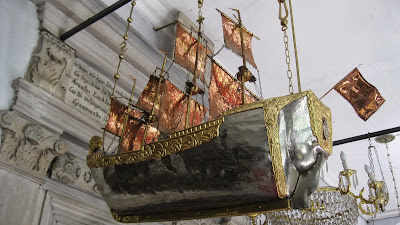
And of course, everybody's favourite, the Haghia Sophia in Sultanahmet.
There are hundreds of Armenian Churches tucked away in corners of Istanbul. As the Armenian population of Istanbul has become smaller, the number of Armenian churches in use has shrunk. One still in operation is the Surp Garabed Armenian Church (Church of St John the Baptist) that I stumbled across on my way to Çinli Camii in the Murat Reis neighbourhood of Üsküdar. Although the construction date of the church is not known, it is one of the oldest Armenian churches in Istanbul, and has existed at least since the year 1555. The church was originally erected as a small, wooden temple at the firman or royal decree of the sultan. It was to be used by Armenian workers, most of whom had migrated from Muş or Van to work on the construction of many public buildings, including the Mihrimah Sultan Mosque, also in Üsküdar. The church has been rebuilt several times following fires, and the current church was built in stone following the great Yenimahalle Fire in 1888, and is still open for church services today.
 |
| Courtyard of the Üsküdar Surp Garabed Armenian Church |
 |
| Interior of the Üsküdar Surp Garabed Armenian Church |
The Greek Orthodox Patriarchate has been on
the same site since about 1601, although the present Church of St George
only dates from 1720. Like all churches built in Istanbul after the conquest of 1453, it is
small in size as Christians were forbidden to build churches with domes or
masonry roofs. Although its present congregation numbers only a few thousand,
it is still the centre of the Orthodox Church. In its heyday the Ecumenical Patriarch
of Constantinople dominated the religious affairs of the entire Eastern
Christian world.
 |
| The main altar |

 | ||
| The Patriarchal Throne thought to date from the late Byzantine period. |
 |
| A mosaic in the portico |
 |
| Coffins of the martyrs including the bodies of St Omonia, St Theophano and St Euphemia of Chalcedon (present day Kadiköy |
Known in
Greek as the Megali Scholio, or the Great
School, the Özel Fener Rum Lisesi (Fener Greek
Orthodox College)
was founded before the conquest of Istanbul.
It remained the principal Greek institution of secular education throughout the
course of Ottoman history. The present building was designed by the Ottoman
Greek architect Konstantinos Dimadis in 1881 and continues to educate pupils
today, providing a full Turkish curriculum as well as a thorough grounding in
Greek language, literature and religion.

In Byzantine times, there were at least
three monasteries on Heybeliada (Saddle Bag island), then known as Halki. Today,
only the Hagia Triada (Holy Trinity) monastery remains, standing on the crest
of Ümit hill. With a long history that predates the conquest, the building
housed the main Greek Orthodox theological seminary in Turkey until it
was closed in 1971. To this day a former teacher of mathematics visits the
school every Wednesday to take tea and reminisce about his former colleagues and pupils.


Meryem Ana (Church of the Virgin Mary) in Karaköy,
was built in 1583 by Tryfon Karabeinikov. It is more popularly known as Santa Maria
de Kaffa (Panagia Kaphatiani) because it was founded by the Greek community of
Kaffa (Crimean Greeks). It is now the headquarters of the Patriarchate of the
Turkish Orthodox Church whose origins can be traced back to the Greco-Turkish War. In 1922 a pro-Turkish Orthodox group was set up consisting of
the Turkish-speaking, Orthodox Christian Karamanlides
population of Anatolia
who wished to remain both Orthodox and Turkish. The group has had a
turbulent history and religious services ceased to be held in the church in 2008.


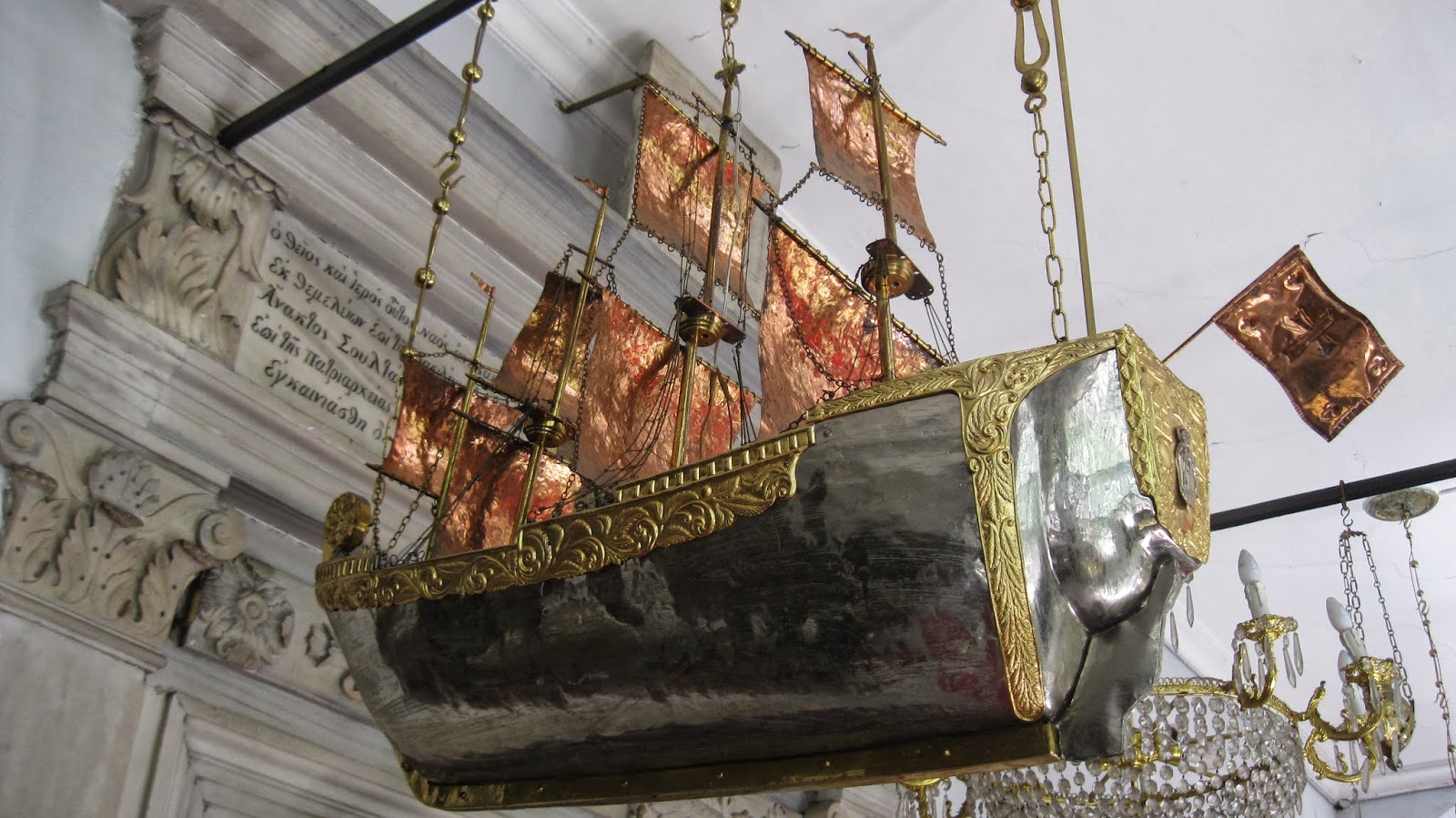
And of course, everybody's favourite, the Haghia Sophia in Sultanahmet.
 |
| Photographed November 2000 |
Thursday, October 17, 2013
Meet me and buy my book
Hi Everyone,
If you've been enjoying my stories you can meet me and buy a copy of my book Inside Out In Istanbul. I will be at Molly's cafe between 2-4.30pm on Thursday the 17th of October. My book is only 12 Euros (30tl). I'd love to hear your feedback in person so come along. You can also try Molly's great coffee and yummy cakes.
See you there,
Lisa Morrow
How to get to Molly's Cafe
If you've been enjoying my stories you can meet me and buy a copy of my book Inside Out In Istanbul. I will be at Molly's cafe between 2-4.30pm on Thursday the 17th of October. My book is only 12 Euros (30tl). I'd love to hear your feedback in person so come along. You can also try Molly's great coffee and yummy cakes.
See you there,
Lisa Morrow
How to get to Molly's Cafe
Tuesday, October 8, 2013
Excerpt from "Lisa's Little Men"
 |
| Republic Square in Kayseri,, Turkey 2002 |
...I am short. I’ve spent most of my life being short except for one brief moment when I was 12 and was the tallest girl in the class. Had I been a boy I would have been the tallest boy then too. Over the years I’ve come to accept that I’ll never wake up with legs up to my ears and am used to most things being just out of my reach. I know I’ll always miss out on knowing what’s going on if I’m standing in a crowd.
When I first came to Turkey
I could almost console myself to being short because Turkish women are short
too. Initially I felt at home because eye level for them was the same for me
and I didn’t feel so hampered by my lack of height in kitchens here. I say
almost, however, because while we share a vertical similarity, their
horizontals are so much smaller and slimmer than mine. Once again I was
prepared to resign myself to the fact that I am short, when I met the first of
my little men.
At that time I was living in Kayseri in
central Turkey.
I was working at a government university and living on campus. From there it
was a very fast and frightening three minute bus ride the four kilometers into
town with a driver who thought he was competing in a Formula One Grand Prix. Red
lights and speeding trucks were never any deterrent to them. When we screeched
to a halt at Republican Square
it was always a relief to get off the bus, even though it did mean leaping
several feet onto the ground from the curiously high set buses.
The old town centre was originally completely enclosed in a towering
granite wall. By the time I arrived the crumbling façade had been clumsily and
controversially rebuilt with poorly mixed concrete. The final result might not
have been aesthetically pleasing but it was practical. Along its base an
assortment of men had carefully set themselves up to ply their trades. The shoe
shiners lined up next to one another, each sitting behind an even more
elaborate brass plated, boat-shaped cleaning kit. They were lavishly decorated
with postcards featuring portraits of luscious female Turkish singers and impressively
masculine Turkish performers proudly showing off bristling moustaches. Their
ranks were supplemented by five men sitting at ancient tabletop treadle sewing
machine with the original glistening gold lettering, repairing shoes. All of
them displayed coloured shoe laces by draping them over a piece of string suspended
the length of the table. When the wind blew and the call to prayer sounded they
seemed like Hawaiian dancers undulating in time to the music.
All of the trees in the row planted in line with the wall had been
claimed. At each stood a man with a cart, usually made by a converting an
old-fashioned baby carriage, offering a startling range of goods and services.
I still smoked back then, and I went to the third tree from the left, where a
little man, dressed winter and summer in a long-sleeved shirt covered by a
hairy jumper, would refill my lighter. After being caught out by a burst of gas
the first time I went to him, I always stood upwind when he inserted the nozzle
of a bottle of butane into my lighter and refilled it. At other times I waited
as he started up his portable generator and turned on his laminating machine to
cover a new identity card or travel pass with plastic. Along with the men at
the other trees he sold mobile phone cases, pens, worry beads and an assortment
of other small things...
This is an excerpt from my new collection of short essays about life in Istanbul available next year. I have more stories available in my current collection called Inside Out In Istanbul. Click on the book title today to buy your copy in paperback or as an ebook.
Tuesday, October 1, 2013
San Francisco Radio - Orient Express show no. 2
Want to learn more about Turkish weddings and köçek dancers? Listen to me on the KKUP Orient Express show on San Francisco Turkish Radio (24.9.2013). Listen to the complete show or tune in at 54 minutes 20 seconds just to hear me. Click Lisa Morrow on Orient Express to start. I hope you enjoy it!

Subscribe to:
Posts (Atom)